Agile Home: Automating Appliances Around Octopus Agile Pricing
Background
Octopus Agile is a half-hourly electricity tariff where prices vary based on wholesale market conditions. Rates can range from negative (Octopus literally pays you to use electricity) to over 60p/kWh during peak demand. The average is around 15–25p, but the spread is wide enough to make smart scheduling genuinely worthwhile.
I built Agile Home — a native Android app backed by a small server — to automate two appliances around these variable rates: a hot water heater and a Miele upright freezer.
The Setup
- Hot water heater — a Tuya-compatible immersion heater controlled via the Tuya Cloud API
- Miele FN 4722 E WS upright freezer — controlled via the Miele 3rd Party Developer REST API
- Server — a Flask API running on a Hetzner VPS, with cron jobs firing every 30 minutes
- App — a native Android app (Java, minSdk 26) that displays status and allows manual overrides
Electricity rates are fetched from the Octopus Energy GraphQL API and cached in a local JSON file.
Hot Water Heater Logic
The heater cron script runs every 30 minutes and makes one of several decisions:
Normal operation
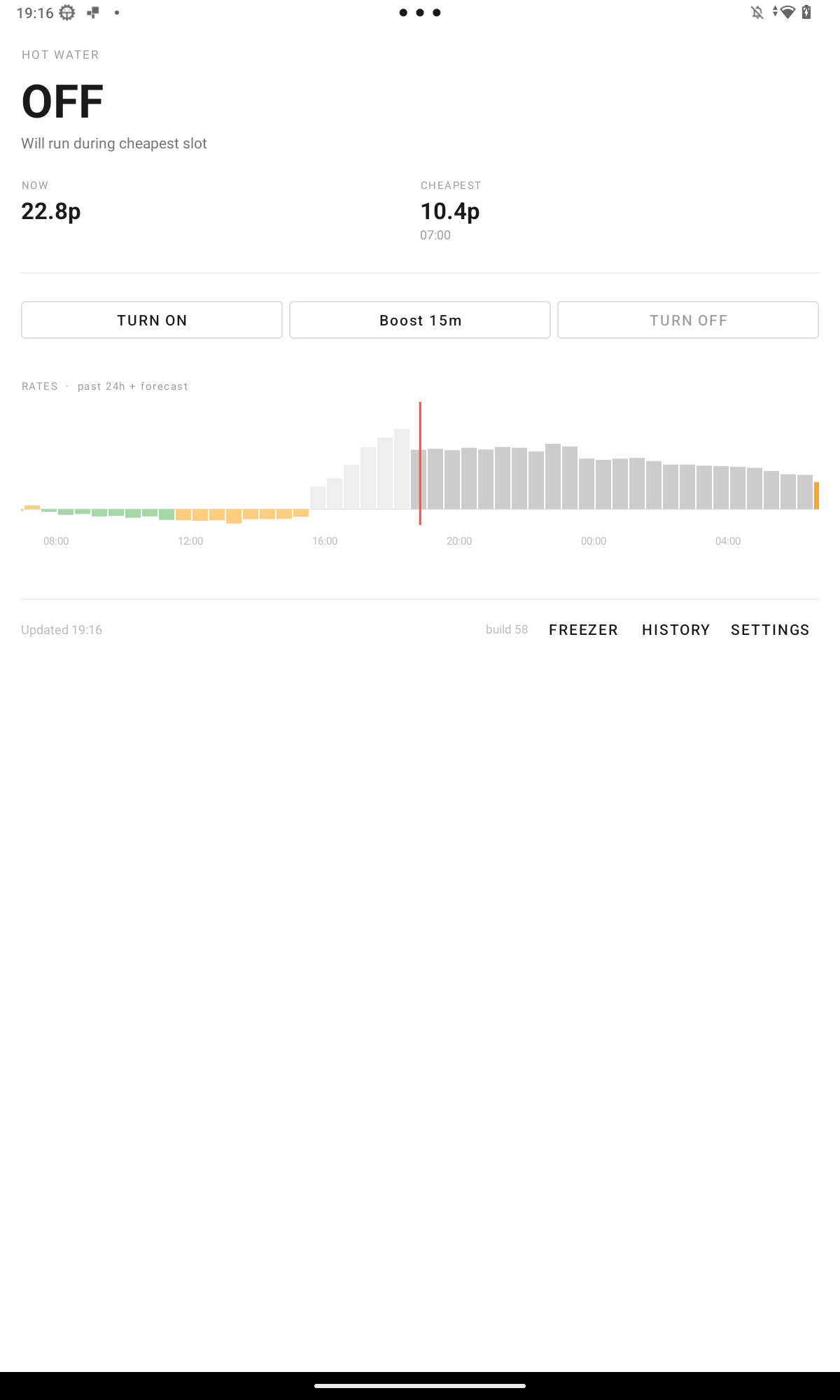
The script finds the cheapest upcoming half-hour slot and turns the heater on during that window for a configurable duration (default 15 minutes). A configurable threshold (skip_above_pence, currently 25p) prevents heating during expensive slots entirely.
Negative rates
When negative-rate slots exist, the script identifies the most negative slots up to the number needed to heat the tank, and runs exclusively during those. Octopus is paying you to heat your water. During a negative period the heater runs for the full half-hour slot; the 15-minute on-duration used for cheap positive slots doesn’t apply here.
Cooldown
After a scheduled heating cycle at a positive rate, a configurable cooldown period (default 3 hours) prevents re-firing too soon — a full tank doesn’t need heating again immediately. Importantly, a manual boost (a short 15-minute override) is excluded from the cooldown timer, since it’s just a quick top-up rather than a full scheduled cycle. The cooldown is also not applied during negative-rate periods — if there are multiple separate negative windows in a day, the heater will run in each of them.
Boost and manual modes
The app provides a boost button (runs for 15 minutes regardless of rate), a lock-on mode, and a holiday lock-off mode.
Freezer Pre-cooling Logic
A upright freezer is essentially a thermal battery. Running it colder before an expensive peak means the compressor can stay off during the peak, shifting energy consumption to cheaper periods. This is the core idea behind the freezer logic.
Two pre-cooling triggers
1. Lead-time trigger When an expensive slot (>30p/kWh) is approaching within a configurable lead window (default 90 minutes), the freezer target temperature is lowered to pre-cool. The target is calculated dynamically.
2. Negative rate trigger When a negative-rate slot is current or imminent (within 2 hours) and an expensive peak is forecast later the same day, the same dynamic setpoint calculation runs — but because the price differential is typically large (negative rate vs expensive peak), the coast fraction usually hits 1.0 and the setpoint clamps to the minimum. Octopus is paying you to run the compressor; between that and the subsequent “holding” logic (which maintains the pre-cool setpoint through any cheap gap before the peak), the full thermal headroom is preserved.
Dynamic pre-cool setpoint
Rather than a fixed pre-cool target, the setpoint is calculated from two factors:
Warming rate — how fast the freezer drifts toward ambient temperature when the compressor is off:
warming_rate = k × (T_ambient − T_normal)
where k = 0.07 °C/hr per °C differential, calibrated from observation (3°C/hr drift at 25°C ambient with a -18°C normal setpoint). Ambient temperature is fetched daily from the Open-Meteo API (no key required).
Price differential — how aggressively to pre-cool, scaled by the difference between the average pre-cool rate and the average peak rate:
coast_fraction = min(1.0, (avg_peak_rate − avg_precool_rate) / 50p)
A 50p differential triggers maximum pre-cooling; smaller differentials scale proportionally.
Combining them:
desired_coast_hours = coast_fraction × peak_duration_hours
precool_depth       = warming_rate × desired_coast_hours
precool_setpoint    = max(−26°C, round(−18°C − precool_depth))
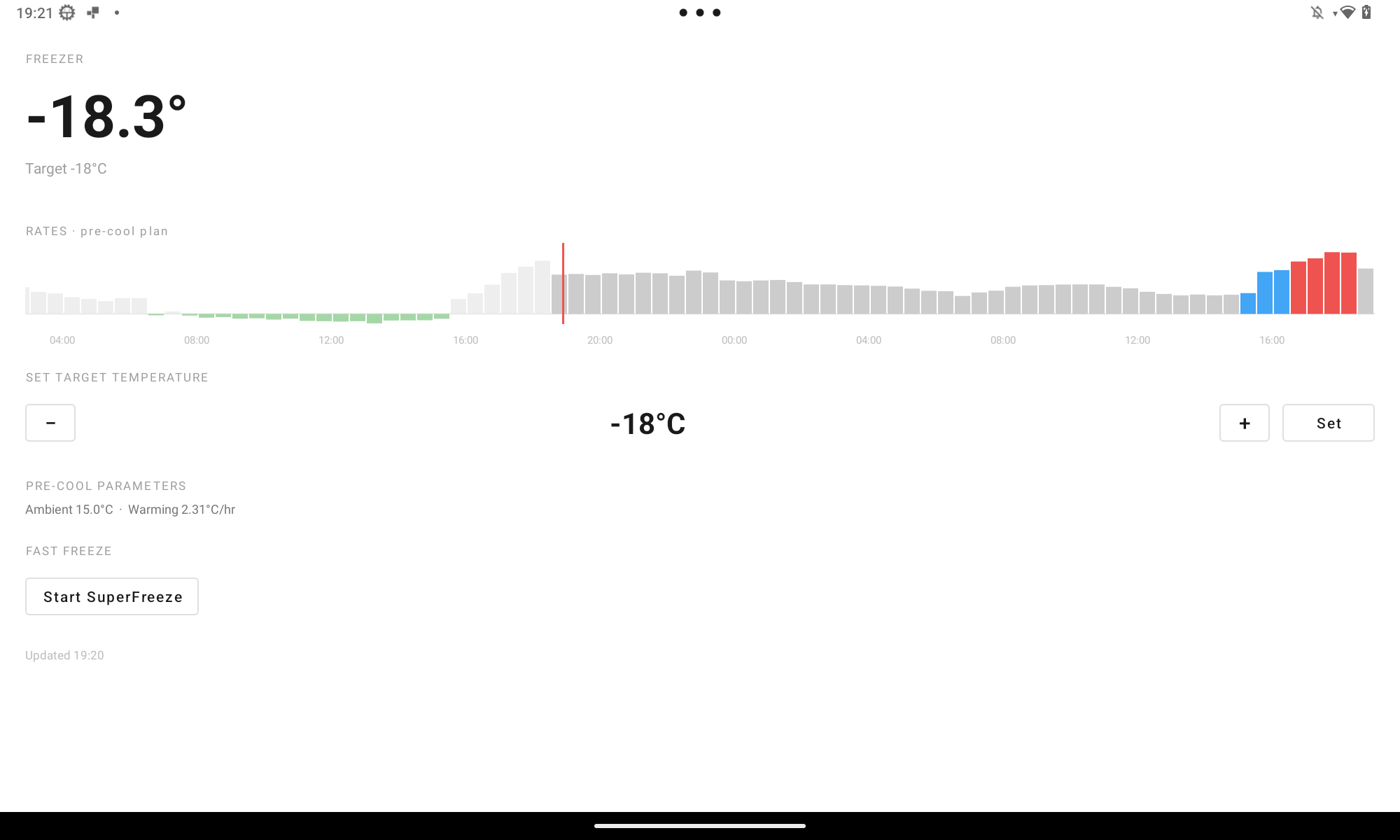
On a typical summer day (15°C ambient, 30-minute lead, 30p peak): warming rate ≈ 2.3°C/hr, which gives a precool depth of around 4–6°C and a target of -22°C to -24°C.
On a day with negative rates ahead of a 60p peak: the differential exceeds 50p, coast fraction = 1.0, and the target clamps to the minimum -26°C.
During the peak
At the start of an expensive slot, the freezer target is restored to -18°C. With the compressor’s thermostat now targeting -18°C and the actual temperature well below that, the compressor stays off — the freezer coasts on its thermal mass. The app shows:
- “Coasting through expensive peak” — when actual temperature is more than 1°C below target (compressor off, genuine coasting)
- “In expensive peak — compressor maintaining” — when the freezer has warmed back to equilibrium
Estimated savings
Each pre-cooling session is logged with an estimated saving:
energy_kwh   = scaled_watts / 1000 × peak_hours
saving_pence = energy_kwh × (avg_peak_rate − avg_precool_rate)
Freezer power consumption is scaled by ambient temperature relative to the 20°C rating condition, since the compressor works harder in summer.
The Android App
The app has four screens:
- Heater — current status, rate, reason for current decision, boost button, lock controls. A scrollable rate chart shows the past 24 hours plus forecast: past slots where the heater ran are shown in pale orange; the planned heating slots (the most-negative ones, or the cheapest positive slot) are shown in amber; other negative slots are green; future positive slots are grey. The “now” line divides past from forecast.
- Freezer — current and target temperature, pre-cooling status, ambient temp and warming rate parameters, manual setpoint control, SuperFreeze toggle. A scrollable rate chart shows the pre-cool plan: blue bars mark the planned pre-cooling window, red bars mark the upcoming expensive peak, grey bars are normal slots.
- History — 7-day bar chart of heater energy/cost or freezer pre-cooling hours, with estimated total savings
- Settings — server URL, API key, skip threshold
The server exposes a REST API (Flask, port 5000, X-API-Key auth) that the app polls every 30 seconds. Freezer status is a combination of live Miele API data and the pre-cooling state written by the cron job.
Results
The system has been running for a few weeks. On days with negative rates ahead of 30–60p peaks, the pre-cooling strategy shifts the freezer’s compressor load almost entirely into negative or very cheap slots. Estimated savings per event are modest (1–3p), but across a year and with the water heater consistently hitting the cheapest slots, the cumulative benefit is meaningful — and the engineering is the point.